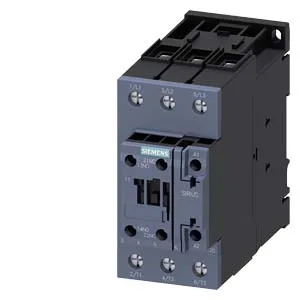
Envelope is 55 mm wide, 114 mm tall, 130 mm deep — fits the S2 frame footprint.
Main contacts are 3-pole normally open (3 NO). Switching frequency varies by duty class: 1200 cycles/hour at AC-1 (resistive), 1000 at AC-3 (standard motor start/run), 750 at AC-2 (slip-ring motor), and 300 at AC-4 (plugging/inching). The AC-3e rating also sits at 1000 cycles/hour. For a typical conveyor or pump cycling every 30 seconds, the AC-3 figure governs — stay under 1000 cycles/hour to avoid overheating the arc chamber. Auxiliary contact ratings are given at multiple voltages: 10 A at 24 V, 2 A at 48 V and 60 V, 1 A at 110 V, 0.9 A at 125 V, 0.3 A at 220 V, 3 A at 400 V, 0.6 A at 440 V, and 40 A at 480 V. The 40 A at 480 V figure likely refers to a specific short-time or making current rating — verify the duty cycle against your PLC input or relay coil load. Motor horsepower rating is 7.5 hp at 230 V — a direct selection anchor for 230 V three-phase motor circuits in North American legacy panels.
Useful when the contactor sits on a swing-out subpanel or a non-standard orientation. Coil terminals are screw-type. Main and auxiliary terminals accept 2x (0.5 to 1.5 mm²) or 2x (0.75 to 2.5 mm²) solid or stranded copper. The storage figure matters for spares kept in unheated warehouses — the contactor can sit at -55 °C without damage, but don't energize the coil below -25 °C. Contact life under AC-3 duty will be lower; plan inspection intervals around the switching frequency and load current. Arcing time is 10 to 20 ms; operating time (coil pick-up) is 10 to 18 ms at AC. These numbers matter for coordination with upstream short-circuit protection devices — the contactor must clear or withstand until the fuse or breaker opens.