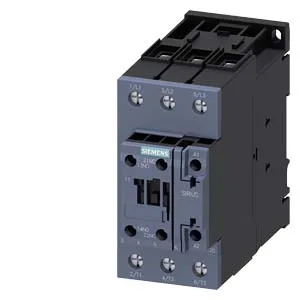
The Siemens 3RT2035-1AR60 is a SIRIUS S2-frame power contactor rated for 40 A at 480 V in AC-3 duty, which means it handles motor switching up to that current under the standard inductive load profile. The coil is screw-terminal type; the main and auxiliary contacts are also screw-clamp, accepting 2x (0.5 to 1.5 mm²) or 2x (0.75 to 2.5 mm²) solid or stranded wire. It mounts via screw or snap-on onto a 35 mm DIN rail per DIN EN 60715, and the mounting position allows ±180° rotation on a vertical surface plus ±22.5° tilt forward and backward.
Sizing and thermal limits
The S2 frame measures 55 mm wide by 114 mm high by 130 mm deep.
Switching frequency and contact ratings
Maximum switching rates: 1 200 cycles per hour in AC-1 (resistive load), 1 000/h in AC-3 (motor starting), and 300/h in AC-4 (plugging/inching). The AC-3e rating matches the AC-3 rate at 1 000/h. Auxiliary contacts are rated for 10 A at 24 V, 2 A at 48 V and 60 V, 1 A at 110 V, 0.9 A at 125 V, 0.3 A at 220 V, and 3 A at 400 V. Main contact configuration is 18 to 1 — meaning one normally-open main pole plus one normally-closed? The evidence shows "For Main Contacts: 18... 1", which likely indicates the auxiliary contact arrangement: one normally-open and one normally-closed auxiliary contact integrated.
Coil and timing
Coil operates at 400 V 50 Hz (and likely 60 Hz given the 0.39 power factor at 60 Hz vs 0.36 at 50 Hz). Arcing time is 10 to 20 ms; the at-AC switching time is 10 to 18 ms. These timing figures matter for coordination with upstream short-circuit protection devices — the arc duration window affects let-through energy calculations for the SCCR.