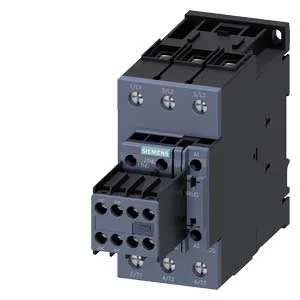
At 55 mm wide and 174 mm deep, it occupies a single DIN-rail module footprint — the width is the panel-space constraint, and the depth fits standard 200 mm+ enclosures without gland-plate interference.
That means you can orient the contactor to match existing busbar runs or cable entry without derating — useful when retrofitting into a crowded panel. Main contact wiring accepts 2x (0.5 to 1.5 mm²) or 2x (0.75 to 2.5 mm²) solid or stranded. The magnet coil uses screw-type terminals — no push-in or spring-cage on the coil circuit, so factor in screwdriver access for commissioning.
The contactor is rated for AC-1 resistive loads at 1,200 operations per hour, AC-3 motor switching at 1,000 ops/h, and AC-4 plugging/reversing at 300 ops/h. The AC-3 rate governs most conveyor and pump duty; the AC-4 rate is the limiting factor for high-inertia or reversing applications — if your cycle rate exceeds 300 per hour under AC-4, this contactor will overheat. Arcing time is 10 to 20 ms, and the closing time (at AC) is 10 to 18 ms. These are fast enough for most motor starters but matter if you're coordinating with upstream short-circuit protection — the arcing time window affects let-through energy calculations. Mechanical life is typical at 10,000,000 operations. Auxiliary contacts are 18 NO to 1 NC.