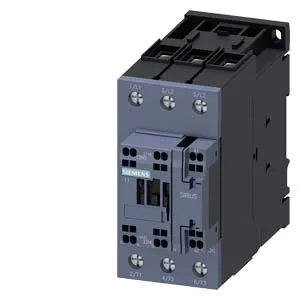
It carries a 480 V AC-3 rating of 40 A — that's the motor-switching current for a pump, fan, or conveyor drive at that voltage — and a 7.5 hp rating at 230 V for smaller North American motor circuits. The S2 frame is the mid-size in the SIRIUS contactor family, balancing panel space (55 mm wide, 114 mm tall, 130 mm deep) against the contact gap needed for 480 V interruption. Mounts on 35 mm DIN rail per EN 60715 via screw or snap-on fastening, and the mounting position allows ±180° rotation on a vertical surface plus ±22.5° tilt forward/backward — useful when the panel layout forces an unconventional orientation. The coil connection uses spring-type terminals, so no screwdriver needed on the coil side; main and auxiliary contacts use screw terminals.
Duty-cycle and switching frequency limits
The contactor's switching frequency depends on the duty class. For AC-1 resistive loads you can cycle it up to 1 200 operations per hour. AC-3 motor switching (starting and running disconnect) allows 1 000 ops/h. The more punishing AC-4 duty — plugging or inching the motor — drops to 300 ops/h. These aren't theoretical ceilings; exceed them and the contact gap temperature rises past the arc-chamber's recovery rate, which accelerates contact erosion. The arcing time sits between 10 and 20 ms, and the magnet coil dropout is 10 to 18 ms at AC.
Environmental range and auxiliary switching
The auxiliary switch block is included (18 to 1 contact configuration for the main contacts), which gives you one N/O or N/C auxiliary for status feedback or interlocking without adding a separate block. The auxiliary contacts carry 10 A at 24 V, derating to 0.3 A at 220 V and 0.6 A at 440 V — enough for PLC inputs or small relay coils at control voltage, but check the volt-amp curve if you're switching a larger contactor's coil through the auxiliary.