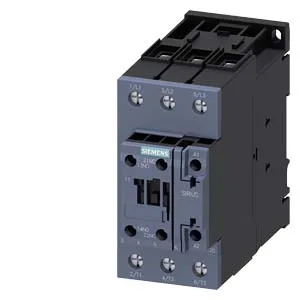
Its headline rating is 52 A at 480 V, which means it can handle a 480 V motor circuit drawing up to 52 A in AC-3 duty — the standard motor-switching category per IEC 60947-4-1. That rating governs the real-world motor size it can start and stop repeatedly without contact wear.
The 52 A at 480 V figure is the AC-3 rated operational current — the maximum continuous current the main contacts can switch under motor starting conditions. For resistive loads (AC-1), the switching frequency is 1 000 operations per hour, while AC-3 motor duty allows 800 operations per hour, and the harsher AC-4 (plugging/reversing) drops to 250 per hour. These limits define the thermal and mechanical endurance for the application. Auxiliary contact ratings are given per voltage: 10 A at 24 V, 2 A at 48 V, 2 A at 60 V, 1 A at 110 V, 0.9 A at 125 V, 0.3 A at 220 V, 3 A at 400 V, and 0.6 A at 440 V. These are the maximum currents the built-in auxiliary switch can break at those voltages — useful for control circuit integration without an add-on block. Dimensions are 130 mm depth, 55 mm width, and 114 mm height — the width is the critical panel-space dimension on a DIN rail, and the depth governs clearance to the enclosure door or rear panel.