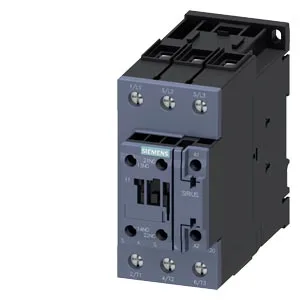
It mounts on a 35 mm DIN rail per DIN EN 60715 using either screw or snap-on fastening, and the mounting position allows +/-180° rotation on a vertical surface plus +/-22.5° tilt forward and backward, which gives flexibility in tight enclosures. The coil is rated 48-80 VDC with a pickup threshold of 0.8 x rated value and a dropout threshold of 1.1 x rated value. Coil inrush peaks at 1 A. Main contacts are configured as 3 normally open poles (3 NO). An auxiliary switch is included as standard, with breaking capacity rated at 10 A at 24 V, 2 A at 48 V and 60 V, 1 A at 110 V, 0.9 A at 125 V, and 0.3 A at 220 V — all DC values. This covers signal-level switching in 24 VDC control circuits and higher-voltage auxiliary loads.
The contactor's maximum switching frequency depends on the duty class: 1,000 operations per hour at AC-1 (resistive loads), 800/h at AC-3 and AC-3e (squirrel-cage motors, starting and disconnecting running), 600/h at AC-2 (slip-ring motors), and 250/h at AC-4 (plugging, inching, reversing). The AC-3e rating of 800/h matches the standard AC-3 figure, which is typical for SIRIUS contactors. For a motor starting every 4.5 seconds, that 800/h limit governs the thermal load on the contactor. These are consistent with a contactor sized for moderate-speed switching in motor control centers.
Panel integration — dimensions, clearances, and wiring
The 3RT2036-1NE30 measures 55 mm wide, 114 mm high, and 130 mm deep. In a densely packed panel, those 6 mm side gaps add up — plan for at least 12 mm between adjacent contactors. The main contact terminals accept screw-type connections for 2 x (0.5-1.5 mm²) or 2 x (0.75-2.5 mm²) solid or stranded wire. The coil terminals are also screw-type.