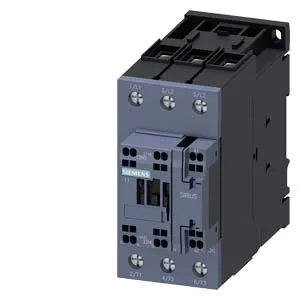
It's rated for 52 A at 480 V and carries a 24 V 50 Hz coil. The coil connection uses spring-type terminals, which cuts down on screw-torque checks during panel build-out. This contactor handles a mechanical life of 10,000,000 operations typical.
That's the number that governs the real-world fit for most motor control applications. The 10 hp rating at 230 V gives a quick reference for North American panel builders matching to motor nameplates. Switching rates vary by duty: AC-1 (resistive) allows up to 1000 operations per hour, AC-3 (motor running) up to 800 per hour, and AC-4 (plugging/inching) drops to 250 per hour. If your application involves frequent reversing or jogging, the AC-4 rate is the limiting factor for thermal rise in the main contacts. Its contact ratings span from 10 A at 24 V down to 0.3 A at 220 V, so you can match the control voltage without derating surprises.
This S2-size contactor measures 55 mm wide, 114 mm high, and 130 mm deep. These aren't just suggestions — they keep arc flash and heat dissipation from cooking adjacent components. Wire size for the main terminals accepts 2x (0.5 to 2.5 mm²) solid or stranded. The coil draws power factor values of 0.36 at 50 Hz and 0.39 at 60 Hz. That's the phase angle between voltage and current — not a number you'll use daily, but relevant if you're sizing a control transformer for a bank of contactors.
The closest functional peer is the 3RT2037-1AF00-ZX95, but that variant carries different coil voltage and terminal options. The 3RT2036-3AC20 with its 24 V 50 Hz coil and spring-type terminals is a specific configuration; a panel built around it won't accept the 3RT2037-1AF00-ZX95 without rewiring the coil circuit. Verify coil voltage and terminal type before substituting.