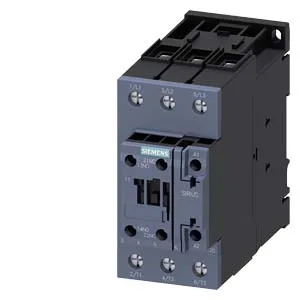
S2 Frame, 65 A AC-3 — What the Ratings Mean
The 3RT2037-1AT60 is a SIRIUS power contactor in the S2 frame size, rated 65 A at 480 V in AC-3 duty — that's the motor-switching current for squirrel-cage motors, not the resistive-heat rating. AC-3 is the standard duty class for starting and disconnecting induction motors under load, so this contactor handles motor starts up to that current without welding the main poles. The screw-type coil terminals accept 2x 0.5 to 1.5 mm² or 2x 0.75 to 2.5 mm² solid or stranded wire — typical for a panel with mixed wire gauges on the same terminal. The auxiliary switch block is present, giving you normally-open/normally-closed contacts for interlocking or status feedback without an add-on module.
Panel Fit and Clearance
Mounting is screw or snap-on onto 35 mm DIN rail per DIN EN 60715 — the S2 frame takes a 55 mm wide slot on the rail. The depth is 130 mm, height 114 mm, so budget that into the enclosure depth and gland-plate clearance. Clearance around the contactor: 10 mm upwards and forwards, 6 mm at the sides, 10 mm downwards — those are the minimum air gaps for heat dissipation and arc quenching. Mounting position is flexible — ±180° rotation on a vertical surface, plus ±22.5° tilt forward or backward. That means it fits in tight enclosures where the rail is oriented non-standard, as long as the arc chamber orientation doesn't trap hot gases.
Switching Duty and Mechanical Life
Maximum switching frequency at AC-3 is 700 operations per hour — that's about one cycle every 5 seconds, typical for a conveyor or pump motor that cycles frequently but not continuously. At AC-4 (plugging/inching) it drops to 200 ops/hour, reflecting the higher contact wear from reversing or jogging under load. The mechanical life is 10 million operations typical — the main contacts will need inspection well before that, but the magnet assembly and spring set hold up. Arcing time is 10 to 20 ms, and the arc chamber clears in that window. The contactor is rated for AC-3e at 700 ops/hour as well — the 'e' suffix indicates enhanced electrical life for the same duty, so it's the same rating with a longer contact erosion margin.
Environmental Range and Storage
Operating temperature is -25 to +60 °C — fine for most indoor panels, but if the enclosure sits in direct sun or near a furnace, check the ambient at the contactor, not the room thermostat. Storage range is wider: -55 to +80 °C, so it can sit in a non-climate-controlled warehouse or truck without damage.