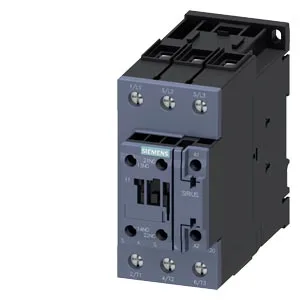
The 3RT2037-1KB40-1AA0 is a SIRIUS coupling contactor in the size S2 frame, designed for switching loads where the coil circuit is electrically isolated from the main power circuit — common in safety interlocks, PLC-driven contactor banks, or any installation where the control voltage (here, 24 V DC) must not share a path with the load side. The coil draws a 2.6 A inrush peak and holds at 0.8 × the rated 24 V DC, so the PLC output or relay driving it must source that peak without voltage sag.
Switching frequency and duty — where this contactor lives
Maximum switching rates vary by load type: 800 operations/hour at AC-1 (resistive), 700 at AC-3 (squirrel-cage motors), 400 at AC-2 (slip-ring motors), and 200 at AC-4 (plugging/inching). The AC-3e rating also sits at 700 ops/hour. For a conveyor running at 30 starts per hour, this is plenty; for a high-cycle pick-and-place station, the AC-4 ceiling of 200 ops/hour is the hard limit. The main contact configuration is 3-pole (18…1), meaning three normally-open main contacts plus one normally-closed auxiliary contact built in. The auxiliary switch is included, so you don't need a separate side-mount block for basic feedback or status indication. Contact erosion depends on the switched current and duty class; at AC-3 rates, expect the electrical life to be shorter than the mechanical figure.
Auxiliary contact breaking capacity — voltage matters
If you're switching a 24 V DC PLC input, the 10 A rating is well above the typical 10-50 mA load, but at 220 V DC the contact is only good for 0.3 A — that's a hard limit for any DC-13 or resistive load at that voltage.