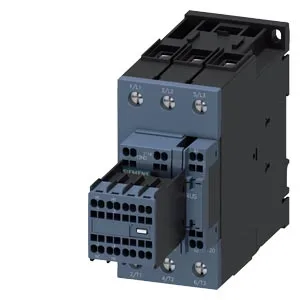
SIRIUS 3RT2037-3NE34 — Size S2 Power Contactor with 48-80 V Coil
Its coil is rated for 48 to 80 V, with a pickup threshold of 0.8 times the rated value and a dropout of 1.1 times the full-scale value — meaning the coil pulls in reliably at 38.4 V and drops out at 88 V, giving a clean hysteresis band for noisy DC supplies. The main contact configuration is 18 normally open contacts and 1 normally closed contact (18 NO + 1 NC), arranged for three-pole motor switching with an auxiliary mirror contact for feedback. No separate auxiliary switch block is fitted as standard, so the built-in NC is the only signal contact on the device. Mechanical life is rated at 10 million operations typical, with switching frequencies that depend on the duty class: 800 cycles per hour in AC-1 (resistive), 700 in AC-3 (squirrel-cage motors), 400 in AC-2 (slip-ring motors), and 200 in AC-4 (plugging/inching). The AC-3e rating also allows 700 cycles per hour, matching the standard AC-3 figure for modern energy-efficient motors.
Coil and Timing Characteristics
Coil holding power is 2 VA at both 50 Hz and 60 Hz, with an inrush current peak of 1 A at 24 V, tapering to 0.3 A at 220 V. The intermediate values — 2 A at 48 V, 2 A at 60 V, 1 A at 110 V, 0.9 A at 125 V — show the coil's impedance rise as voltage increases, which keeps the thermal load manageable across the operating range. These figures matter for coordination with upstream short-circuit protection — the total break time of roughly 40 to 75 ms must be within the let-through energy curve of the selected fuse or MCCB.
Dimensions are 114 mm high, 55 mm wide, and 178 mm deep. The 55 mm width is the critical panel-space dimension — it occupies three 18 mm module positions on a DIN rail, so plan for three adjacent slots in the enclosure layout. Coil terminals are spring-type (cage clamp), accepting 2 x 0.5 to 2.5 mm² solid or stranded wire. Strip length for spring terminals is typically 8-10 mm; the spring mechanism eliminates the need for retorquing during thermal cycling, which is a maintenance advantage in high-vibration environments like compressor skids.