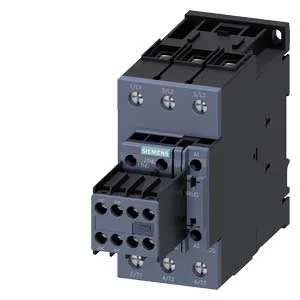
It carries no built-in auxiliary switch block, so if you need N.O./N.C. feedback for a PLC or status lamp, you add a separate auxiliary contactor block that snaps onto the front. Its headline rating is 65 A at 480 V in AC-3 duty, which is the standard motor-switching category per IEC 60947-4-1 — that means it can make and break a locked-rotor current of about 6× rated, so it handles starting a 65 A FLA motor without welding contacts. At 230 V it carries a 15 hp motor load. The coil is 24 VDC, drawing 6 A at rated voltage. That's a high inrush for a DC coil — verify your 24 VDC supply can deliver the peak without droop, especially if you're driving multiple contactors from the same power supply. The coil holds at 24 VDC nominal; dropout voltage is not listed here, but typical SIRIUS DC coils drop out around 18 V.
The Size S2 footprint is 55 mm wide, 114 mm tall, 174 mm deep. Clearance: 10 mm above and below, 10 mm forward, 6 mm to the side. Wire range: accepts 2× (0.5–1.5 mm²) or 2× (0.75–2.5 mm²) solid or stranded. Screw terminals are standard — no spring-cage option on this variant.
Switching frequency and endurance
Maximum switching rates: 700 cycles/hour in AC-1, 500 in AC-3, 350 in AC-2, 150 in AC-4. For AC-3e (enhanced) it's also 500 cycles/hour. If your application cycles faster than these rates, you'll need to derate or move to a larger frame.