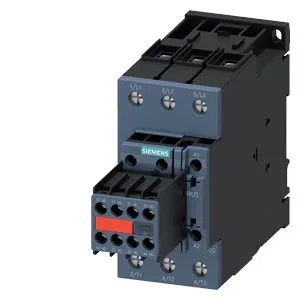
It mounts via screw and snap-on onto 35 mm DIN rail per DIN EN 60715, and the mounting position is flexible — +/-180° rotation on a vertical surface, plus +/-22.5° tilt forward or backward. That helps when you're retrofitting into a cramped enclosure and the rail is at an odd angle. The coil is screw-type terminals, rated 20-33 V, with an inrush peak of 3 A and a holding draw of 2 VA at 50 or 60 Hz. Switching capacity at 24 V rated value is 6 A, at 48 V it's 2 A, and at 220 V it's 0.3 A. That's the inductive load curve — the contactor can handle a fair spread of control voltages, but the higher the voltage, the lower the current it can break.
Clearances and panel integration
Physical footprint: 55 mm wide, 114 mm tall, 174 mm deep. That's tight enough to pack several contactors side by side in a multi-row DIN rail assembly, but allow the forward gap for arc venting. That covers most indoor panel environments, even unheated warehouses. The contactor is rated for AC-1 (resistive) at 700 operations per hour maximum, AC-3 (motor starting) at 500 ops/h, and AC-4 (plugging/inching) at 150 ops/h. If your application cycles faster than that, you'll need to derate or pick a larger frame.