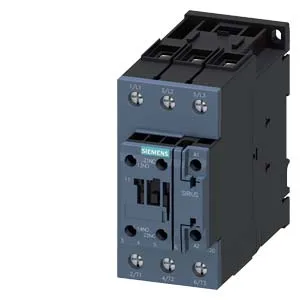
It's built for a 24 V DC coil, so it plays nice with PLC outputs and standard DC control buses. The 65 A rating at 480 V tells you it'll handle a 30 HP motor on 480 V three-phase without sweating, and the 15 hp at 230 V covers single-phase or lower-voltage applications. The coil inrush peaks at 3 A, so size your DC supply for that momentary draw — a 24 VDC power supply with a 5 A continuous rating will hold it fine.
Mounting and fit
The size S2 footprint is 55 mm wide, 114 mm tall, and 130 mm deep — that depth includes the coil terminals and arc chamber, so measure your enclosure depth before you drill. Clearance distances: 10 mm up, 10 mm down, 6 mm to the side. Wire size: 2x 0.5 to 1.5 mm² solid or stranded, or 2x 0.75 to 2.5 mm² — spring-cage terminals would be easier, but these are screw-type, so torque them to the manufacturer's spec and you're set.
Switching DC loads — the real story
DC switching is where contactors earn their keep or get smoked. The 3RT2038-1XB40-0LA2 has a DC-13 switching curve: at 24 V rated value it handles 10 A, at 48 V it drops to 2 A, at 60 V still 2 A, at 110 V just 1 A, at 125 V 0.9 A, at 220 V 0.3 A, at 400 V 3 A, at 440 V 0.6 A, at 500 V 2 A, and at 600 V 62 A. That last one — 62 A at 600 V — looks like a misprint or a special DC-1 resistive rating (the evidence says 'at 600 V rated value 62 A'), so if you're switching DC motors or solenoids above 250 V, verify the load type against the full datasheet. The arcing time runs 10 to 20 ms, and the dropout time is 30 to 55 ms at DC — that matters for sequencing multiple contactors in a safety circuit.