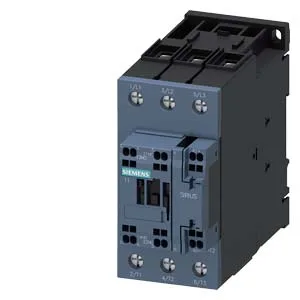
Panel fit and coil details
The DC coil pulls 1.5 A inrush and picks up at 70% of rated voltage; dropout is at 125% of rated, with a dropout time of 30 to 55 ms. That dropout window matters for sequencing logic — if your control scheme relies on a fast drop, the 30 ms floor is the number to design around.
Rated 65 A at 480 V and 62 A at 600 V — those are the AC-3 motor-switching figures that govern real motor loads. The 65 A at 480 V means it can handle a 50 hp motor at 480 V three-phase; the 62 A at 600 V covers a 60 hp motor at that voltage. For resistive loads (AC-1), the contactor carries higher current, but the motor-duty number is the one that decides fit for pump, fan, or compressor duty. The main contact configuration is listed as 18 to 1 — that's 3 normally open power poles plus 1 normally open auxiliary, with a separate auxiliary switch block included.
Dimensions: 114 mm high, 55 mm wide, 130 mm deep. The 55 mm width is the DIN-rail footprint — it occupies three 18 mm module spaces, which is standard for a size S2 contactor. That 6 mm side clearance is tighter than the vertical clearances, so when packing multiple contactors side-by-side on the rail, the 6 mm gap is the limiting dimension. Wire size: 2 x 0.5 to 2.5 mm² solid or stranded — spring terminals, so no screw torque to verify, but strip length must be consistent.
Switching performance and auxiliary ratings
For DC switching, the arc extinguishes faster than AC because of the natural current zero, but the 10-20 ms window is normal for a DC coil contactor at these power levels. Maximum switching frequency in AC-4 duty (plugging/reversing) is 150 operations per hour — that's the limit for severe switching, not continuous running. For the auxiliary contacts, rated currents at various DC voltages: 10 A at 24 V, 2 A at 48 V, 2 A at 60 V, 1 A at 110 V, 0.9 A at 125 V, 0.3 A at 220 V, 3 A at 400 V, 0.6 A at 440 V, 2 A at 500 V.