Duty cycle and switching frequency
Switching frequency depends on the duty class: AC-1 (resistive loads) maxes at 900 cycles per hour, AC-3 (standard motor starting) at 1,000 cycles per hour, AC-2 (slip-ring motor starting) at 400, and AC-4 (plugging/inching) at 300. The AC-3e rating also comes in at 1,000 cycles per hour. For a conveyor or pump running a normal start/stop cycle, the AC-3 figure is what governs — 1,000 ops/hour is comfortably above most line rates. Mechanical life is typical at 10 million operations. Arcing time runs 10 to 20 ms, and the make time at AC is 10 to 21 ms. Those are the numbers you'd plug into a coordination study if you're checking selectivity with an upstream breaker.
Termination and auxiliary contacts
Main circuit terminals accept solid conductors from 2.5 to 16 mm² and stranded from 6 to 70 mm². The auxiliary circuit takes 2x (0.5 to 1.5 mm²) or 2x (0.75 to 2.5 mm²) solid or stranded. That covers most panel wiring — no need for special ferrules or adapters unless you're running a very heavy feeder. Its rated values vary by voltage: 6 A at 24 V, 2 A at 48 V and 60 V, 1 A at 110 V, 0.9 A at 125 V, 0.3 A at 220 V, 3 A at 400 V, and 0.8 A at 440 V. The 230 V rating is given in horsepower — 15 hp. Coil consumption is 0.35 A at 50 Hz and 0.41 A at 60 Hz. That's the magnet coil draw — factor it into your 24 VDC power supply sizing, especially if you're ganging several contactors in one cabinet.
Dimensions and clearances
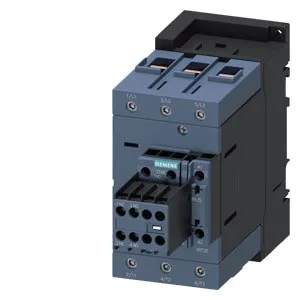
The contactor measures 140 mm high, 70 mm wide, and 195 mm deep. That depth is the dimension you need to watch when fitting it into a shallow enclosure — 195 mm is deeper than a typical IEC contactor in this frame class, so check the back-can clearance. Those are the ventilation and arc-chamber spacing — don't crowd them if you want full rated life.