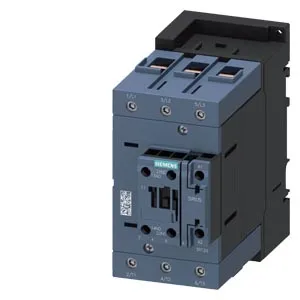
Its 70 mm width, 140 mm height, and 152 mm depth fit standard panel layouts with the following clearance requirements: 10 mm upwards, 20 mm forwards, 10 mm downwards, and 10 mm at the side for heat dissipation and arc containment. The main contacts are rated for AC-3 duty at up to 1,000 switching cycles per hour, with an arcing time of 10 to 20 ms. This switching frequency suits motor starting applications where the contactor sees repeated engagement under load — conveyor drives, pump starts, compressor cycling. The AC-4 rating drops to 300 cycles per hour, reflecting the higher electrical stress of inching or plugging duty. Auxiliary contacts are present, rated at 10 A at 24 V, 2 A at 48 V, 2 A at 60 V, 1 A at 110 V, 0.9 A at 125 V, 0.3 A at 220 V, and 3 A at 400 V. These ratings define the signal-level switching capability for control circuits — interlocking, status feedback, or PLC inputs — and must be derated per the voltage curve, not treated as a single blanket current.
Main circuit wiring accepts solid conductors from 2.5 to 16 mm² and stranded conductors from 6 to 70 mm². The magnet coil uses screw-type terminals. Auxiliary contact wiring accepts 2x (0.5 to 1.5 mm²) or 2x (0.75 to 2.5 mm²) solid or stranded conductors. These cross-section ranges cover standard motor feeder cables up to about 50 mm² and control wiring down to 0.5 mm².