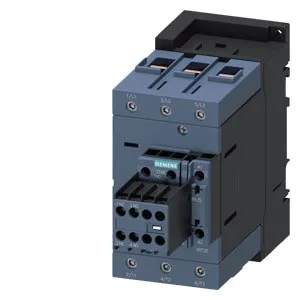
It mounts via screw or snap-on onto 35 mm DIN rail per DIN EN 60715, and the mounting position allows +/-180° rotation on a vertical surface plus forward/backward tilt of +/-22.5° — handy when you're squeezing it into a crowded enclosure and need to orient the coil terminals toward the gland plate. The contactor carries an auxiliary switch as standard. Main contacts are rated for 10 to 2 A. Coil termination is screw-type, accepting solid conductors from 2.5 to 16 mm² and stranded from 6 to 70 mm².
Switching duty and thermal limits
Maximum operating cycles per hour vary by duty: 900/h in AC-1 (resistive loads), 400/h in AC-2 (slip-ring motors), 1 000/h in AC-3 (squirrel-cage motors — the common one), and 300/h in AC-4 (plugging/inching). The AC-3e rating matches the AC-3 figure at 1 000/h. Arcing time sits between 10 and 20 ms, with a coil pick-up time in the same window (10–21 ms). That storage range is wider than the operating range — it's a handling spec, not a running spec, so don't let the part sit in a hot warehouse above 60 °C and expect it to start right up.
Physical footprint and clearances
Dimensions: 70 mm wide, 140 mm high, 195 mm deep.