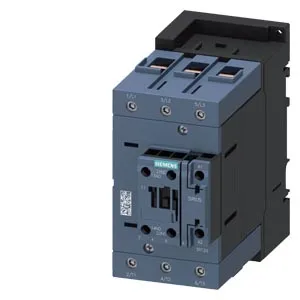
At 230 V it's rated 15 hp, so it covers a common three-phase motor range in North American panels. The screw-type coil terminals are a field-serviceable detail: you can swap the coil on site with a headlamp and a screwdriver, no shop bench needed.
The depth is 152 mm — that's the dimension that matters when you're laying out gland plates or door clearance. Width is 70 mm, height 140 mm.
Wiring terminals
Main circuit terminals accept solid conductors 2.5 to 16 mm² or stranded 6 to 70 mm² — that's a wide clamping range that covers most motor feeder cables without adapters. Auxiliary switch terminals take 2x (0.5 to 1.5 mm²) solid/stranded or 2x (0.75 to 2.5 mm²). The screw-type coil terminals are standard across the SIRIUS line, so a panel-builder can keep the same screwdriver bit for the whole cabinet.
Switching performance and mechanical life
Rated for 10 million mechanical operations typical. Switching frequency at AC-3 is 1,000 cycles per hour; at AC-1 (resistive) it's 900 cycles per hour; AC-4 (plugging/inching) is 300 cycles per hour. Arcing time is 10 to 20 ms at 50 Hz. The 0.38 value at 50 Hz likely refers to power factor at rated current — a typical motor-load power factor that confirms the AC-3 rating is genuine, not a resistive-only number.
Environmental and auxiliary specs
The auxiliary switch is included. Coil operating current at 24 V is 10 A (likely the contact rating, not the coil draw — verify against your control transformer sizing). At 400 V the auxiliary contacts are rated 3 A.