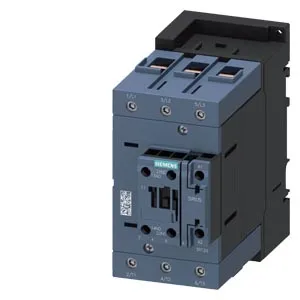
Siemens SIRIUS 3RT2045-1AV60 — 77 A Power Contactor, Size S3
The Siemens SIRIUS 3RT2045-1AV60 is a size S3 power contactor rated 77 A at 480 V in AC-3e duty, meaning it handles motor switching loads up to that current in a standard 480 V three-phase panel. The screw-type terminals accept solid conductors from 2.5 to 16 mm² and stranded from 6 to 70 mm², so the wiring range covers most motor branch circuits without a separate terminal adapter. Mounting is via screw or snap-on onto 35 mm DIN rail per DIN EN 60715, with a ±180° rotation allowance on vertical surfaces and ±22.5° tilt forward/backward — useful when panel layout forces an unconventional orientation.
Duty Ratings and Switching Life
Maximum switching frequency varies by duty: 1 000 operations per hour in AC-3 and AC-3e, 900 in AC-1 resistive, 400 in AC-2, and 300 in AC-4. For a conveyor or pump running AC-3 duty, that 1 000 cycles/h ceiling is rarely limiting — it corresponds to a cycle every 3.6 seconds. The mechanical life is typical 10 000 000 operations, so the contactor outlasts most panel designs before a wear-out replacement is needed. Auxiliary contact ratings are provided for DC switching: 10 A at 24 V, 2 A at 48/60 V, 1 A at 110 V, 0.9 A at 125 V, 0.3 A at 220 V, and 3 A at 400 V. The 24 V DC rating of 10 A is generous for pilot-duty control circuits; the 0.3 A at 220 V DC is the figure to watch if you're switching a DC coil on a higher-voltage control bus.
The 60 °C ceiling is standard for enclosed panels with moderate heat rise; if the contactor sits near a drive or transformer inside the same cabinet, check the internal ambient doesn't exceed that. Minimum clearances: 10 mm upwards, 10 mm downwards, 20 mm forwards, 10 mm at the side — the 20 mm forward clearance is the tightest constraint in a shallow enclosure. Arcing time is 10 to 20 ms, and the make/break time at AC is 10 to 21 ms. These are fast enough for standard motor starting but not for high-speed DC switching where arc extinction time matters more — the DC auxiliary ratings already reflect that limitation.