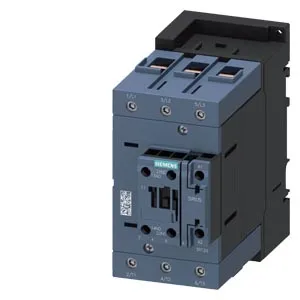
SIRIUS S3 coupling contactor, 24 VDC coil
DC switching capacity and coil draw
Rated coil voltage is 24 VDC; inrush current peaks at 2.7 A. The contactor switches DC loads at 10 A at 24 V rated value, 2 A at 48 V and 60 V, 1 A at 110 V, 0.9 A at 125 V, and 0.3 A at 220 V. That 10 A at 24 VDC is the headline figure for most control-circuit isolation or DC-motor switching applications — the derating curve above 24 V is steep, so verify your load voltage against the table before specifying.
Switching frequency per duty class
Maximum switching rates are duty-dependent: 900 cycles/hour at AC-1 (resistive), 400/h at AC-2 (slip-ring motors), 1 000/h at AC-3 (squirrel-cage motors — start only), 300/h at AC-4 (plugging/inching), and 1 000/h at AC-3e (enhanced AC-3). The AC-3 and AC-3e rates of 1 000/h are the highest here, but that's for starting duty only — if your application includes inching or reversing, the AC-4 limit of 300/h is the governing number.
Auxiliary contacts and mechanical endurance
An auxiliary switch is fitted. Arcing time runs 10–20 ms; opening time at DC is 38–57 ms. Shock resistance is 16.3 g at 5 ms and 10 g at 10 ms — enough for most industrial panels but worth checking if the contactor is mounted near a large hammer-mill or press.
Main circuit terminals accept solid 2.5–16 mm² or stranded 6–70 mm². Auxiliary terminals take 2x (0.5–1.5 mm²) solid or stranded, or 2x (0.75–2.5 mm²). That 70 mm² stranded capacity on the main terminals is generous for a size S3 frame — it can handle the larger cable gauges typical of 30–40 A motor circuits without needing a terminal reducer.
Environmental range and clearances
The 20 mm forward clearance is the one that catches panel layouts — if the enclosure door or busbars are tight, that dimension decides fit.