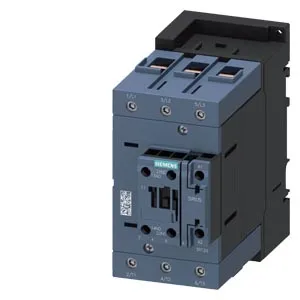
It mounts on 35 mm DIN rail per DIN EN 60715 via screw or snap-on fastening, and the mounting position allows +/-180° rotation on a vertical surface plus +/-22.5° tilt forward or backward — handy when you're shoehorning it into a crowded enclosure and the rail isn't perfectly square. The coil accepts 48 to 80 VDC (rated value), with an inrush current peak of 1.1 A and a hold power of 3.5 VA at both 50 and 60 Hz. That's a broad pickup range, so you don't need a tightly regulated DC supply — a rectified bus or battery-backed rail will hold it in. Main contacts are rated for AC-1 (resistive) at 900 switching cycles per hour maximum, AC-3 (motor starting) at 1000 cycles/h, AC-4 (plugging/inching) at 300 cycles/h, and AC-3e (enhanced motor) also at 1000 cycles/h. The AC-3 figure tells you this contactor is sized for frequent motor starts on conveyors, pumps, or fans — not just occasional jogging.
Wiring and integration notes
Main power terminals accept solid wire from 2.5 to 16 mm² and stranded from 6 to 70 mm² — that's a wide range covering everything from control-circuit feeds to motor leads on a 30-40 A motor. Auxiliary terminals take 2x (0.5 to 1.5 mm²) or 2x (0.75 to 2.5 mm²) solid or stranded. Screw-type terminals throughout, so no special crimp tool needed on the van. Dimensions are 140 mm high, 70 mm wide, 152 mm deep. The 70 mm width is the S3 frame standard — it'll fit a standard 8-module DIN-rail slot. That forward clearance is the one to watch — 20 mm means you need room for the arc chamber to breathe, especially if you're running near the AC-4 cycle limit. The storage spec is wider because the contactor isn't dissipating heat in the box — if it's sitting in a cold warehouse, it'll be fine. The 60 °C operating ceiling means derate your enclosure ambient if it's near a heat source like a drive or transformer.
It carries an auxiliary switch built in, so you don't need to order a separate side-mount block for feedback to the PLC or status indication on the panel door. The auxiliary contact ratings are 10 A at 24 V, 2 A at 48 V, 2 A at 60 V, and 1 A at 110 V — enough to drive a small relay or a PLC input directly.
The mechanical life is listed at 10,000,000 cycles typical. Arcing time is 10 to 20 ms, and the make/break times (both AC and DC) are 38 to 57 ms. Those numbers matter for coordination with upstream fuses or breakers — if the arcing time overlaps with a fast semiconductor fuse, you could lose the fuse on a normal start. For most motor circuits with standard gG fuses or thermal-magnetic breakers, it's fine. The contactor's main contact configuration is listed as "10... 2" — that's a 3-pole contactor with normally open main contacts, and the auxiliary is a 1 NO + 1 NC configuration. If you need more auxiliary contacts, you'll add a side-mount block, but the built-in set covers basic feedback.