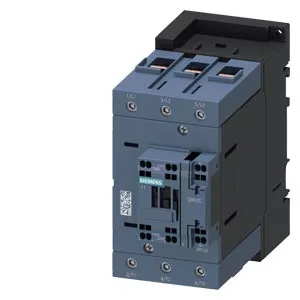
The spring-type terminals on the magnet coil and the main circuit accept solid conductors from 2.5 to 16 mm² and stranded from 6 to 70 mm², while auxiliary wiring uses 2x (0.5 to 2.5 mm²) stranded or solid. That terminal range covers most panel wiring from control circuits up to motor feeders.
This contactor is rated for different switching frequencies depending on the duty category. In AC-3 (squirrel-cage motor starting) it handles up to 1,000 operations per hour, and the same rate applies for AC-3e. For AC-1 resistive loads the maximum is 900 cycles/h, AC-2 (slip-ring motor) drops to 400 cycles/h, and AC-4 (plugging/inching) is limited to 300 cycles/h. The mechanical life is a typical 10,000,000 cycles, so this is a fast-mover spare for high-cycling applications like conveyors or pumps. The auxiliary switch is included, with rated currents at various control voltages: 10 A at 24 V, 2 A at 48 V and 60 V, 1 A at 110 V, 0.9 A at 125 V, 0.3 A at 220 V, 3 A at 400 V, and 0.8 A at 440 V (–). These numbers govern the control circuit you can drive directly from the aux contacts — useful for PLC inputs or relay coils in the same panel.
The contactor measures 70 mm wide, 140 mm high, and 152 mm deep. Arcing time is 10 to 21 ms at AC and 10 to 20 ms. Power factor at 50 Hz is 0.35, at 60 Hz is 0.41.