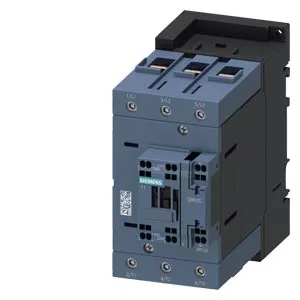
Its compact footprint — 152 mm deep, 140 mm high, 70 mm wide — fits standard control-panel layouts without oversizing the enclosure. Spring-type terminals on the magnet coil accept solid conductors from 2.5 to 16 mm² and stranded from 6 to 70 mm², with auxiliary wiring handled by 2x (0.5 to 2.5 mm²) solid or stranded. The integrated auxiliary switch eliminates the need for a separate add-on block in many motor-starting circuits.
Duty-cycle and switching ratings
Rated for AC-1 resistive loads at 900 operating cycles per hour and AC-3 motor switching at 1,000 ops/h, with AC-3e matching that rate. AC-4 inching/jogging duty is capped at 300 ops/h — stay under that for plug-reversing or high-wear applications. For DC switching, the contactor carries 10 A at 24 V, 2 A at 48 V, 2 A at 60 V, 1 A at 110 V, 0.9 A at 125 V, 0.3 A at 220 V, 3 A at 400 V, and 0.8 A at 440 V. At 230 V AC it is rated 15 hp — a common sizing point for 3-phase motor loads in North American panels.
Environmental limits and lifecycle
These matter for heat dissipation and arc-flash containment — don't crowd the contactor against cable ducts or other devices.