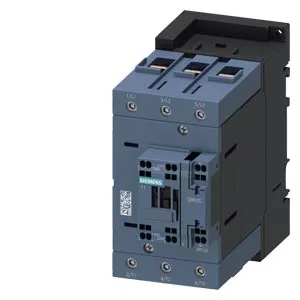
The contactor occupies a 70 mm width, 140 mm height, and 152 mm depth on the rail. The contactor handles switching frequencies up to 1000 cycles per hour under AC-3 and AC-3e maximum duty, 900/h under AC-1, 400/h under AC-2, and 300/h under AC-4.
Wiring and Clearance
The main circuit accepts solid conductors from 2.5 to 16 mm² and stranded conductors from 6 to 70 mm². The auxiliary circuit takes 2x (0.5 to 2.5 mm²) solid or stranded. Coil connection uses spring-type terminals — no screw torque to verify, but ensure the wire is fully seated before closing the clamp. These are the bare-metal spacing requirements; factor in any additional creepage if the panel environment is humid or conductive. Coil power draw at 50 Hz is 0.35 VA; at 60 Hz it is 0.41 VA. The arcing time for the main contacts spans 10 to 21 ms, with a stated arcing time of 10 to 20 ms. This is within the typical window for AC contactors but should be verified against the upstream protection coordination if the circuit is fast-acting.
This covers most indoor industrial panels and unheated warehouses.
The built-in auxiliary switch is rated for switching at various control voltages: 10 A at 24 V, 2 A at 48 V, 2 A at 60 V, 1 A at 110 V, 0.9 A at 125 V, 0.3 A at 220 V, 3 A at 400 V, and 0.8 A at 440 V. At 230 V the rating is 15 hp, which is a motor-starting capacity, not a resistive load figure.