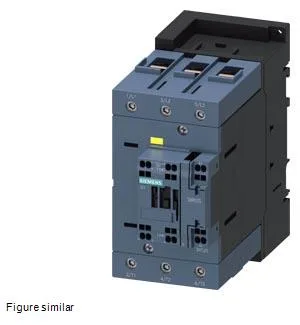
Rated for 1000 operating cycles per hour at AC-3 duty, it handles frequent motor starts — think conveyor drives or pump cycling — without derating for thermal accumulation. The 52 a MTBF gives a reliability baseline for lifecycle planning in continuous-process lines.
The AC-3 switching frequency of 1000 cycles/h is the headline number for motor duty. AC-3 covers starting and switching off squirrel-cage motors under load — the contactor's main job. That 1000 cycles/h means it can cycle a motor on and off every 3.6 seconds continuously within its rated current, which suits high-throughput automation cells. The AC-4 rating of 300 cycles/h applies to plugging and inching duty; if your application reverses the motor under load or jogs it, that lower figure governs the thermal limit. Size S3 defines the physical frame and the current-carrying capacity range. The contactor accepts solid conductors from 2.5 to 16 mm² and stranded from 6 to 70 mm², so it lands on the heavy side of panel wiring — typical for motor branch circuits above 30 A. The 70 mm width and 152 mm depth fit a standard DIN-rail footprint; the 140 mm height leaves clearance under a 200 mm enclosure lid. The auxiliary switch is included, saving a separate order for feedback or status indication to the PLC.