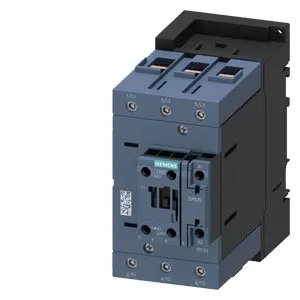
It mounts via screw and snap-on onto 35 mm DIN rail per DIN EN 60715, and the mounting position allows +/-180° rotation on a vertical surface plus +/-22.5° tilt forward/backward — useful when panel layout forces an unconventional orientation. Solid conductor range is 2.5... 16 mm² (stranded 6... 70 mm² for the main circuit), so it accepts standard panel wire sizes without adapters.
Mechanical and electrical endurance
Mechanical life is typical 10,000,000 operations. Main contact switching rates vary by duty: AC-1 (resistive) up to 900 cycles/hour, AC-3 (motor start/run) up to 850 cycles/hour, AC-4 (plugging/inching) up to 250 cycles/hour. The arcing time is 10...20 ms at AC — fast enough to minimize contact wear in repetitive cycling. Auxiliary switch is included (yes), and the contactor is rated for 10 A at 24 V (auxiliary contacts), 3 A at 400 V, and 20 hp at 230 V — so it handles both control and moderate motor loads directly.
Clearance requirements: 10 mm upwards, 10 mm downwards, 20 mm forwards, 10 mm at the side — so a typical 70 mm wide contactor needs at least 90 mm horizontal slot when side-by-side with other devices. The screw-type terminals accept solid 2.5...16 mm² or stranded 6...70 mm², and the auxiliary terminal accepts 2x (0.5...1.5 mm²) or 2x (0.75...2.5 mm²) solid or stranded.