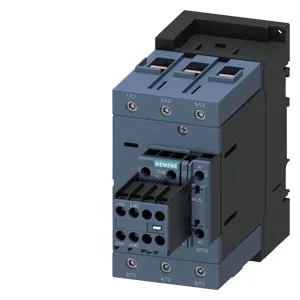
Its 20 hp rating at 230 V tells you it can handle a 20 hp three-phase induction motor on a 230 V line — a common spec for mid-size pumps, fans, and compressors. Mounting is via screw and snap-on onto 35 mm DIN rail per DIN EN 60715, with the mounting position flexible: ±180° rotation on a vertical surface and ±22.5° tilt forward/backward. That means you can orient the contactor to fit tight panel layouts without derating — useful when retrofitting into an existing enclosure where the rail is already placed. The main contacts are rated for 10... 2. Mechanical life is typical 10,000,000 operations.
Coil and auxiliary contact ratings — the so-what
The coil is screw-type, accepting solid conductors 2.5... 16 mm² and stranded 6... 70 mm². That is a wide range — you can land a 2.5 mm² control wire or a 70 mm² power cable without adapters. The coil draws 0.35 A at 50 Hz and 0.41 A at 60 Hz — a standard control-transformer load that a 24 VDC or 24 VAC supply can handle without oversizing. Auxiliary contact ratings are given at several voltages: 6 A at 24 V, 2 A at 48 V, 2 A at 60 V, 1 A at 110 V, 0.9 A at 125 V, 0.3 A at 220 V, and 3 A at 400 V (–). At 24 VDC the 6 A rating is generous for a control circuit; at 400 VAC the 3 A rating covers small contactor coils or indicator loads.
Switching frequency and thermal limits
Maximum switching rates are specified per duty class: 900 cycles/hour for AC-1 (resistive loads), 850 cycles/hour for AC-3 (squirrel-cage motors), 350 cycles/hour for AC-2 (slip-ring motors), and 250 cycles/hour for AC-4 (plugging/inching) (–). For a motor-starting application (AC-3), 850 cycles/hour means the contactor can switch a motor on and off every ~4.2 seconds continuously — typical for a fast-cycling conveyor or a compressor with short run times.