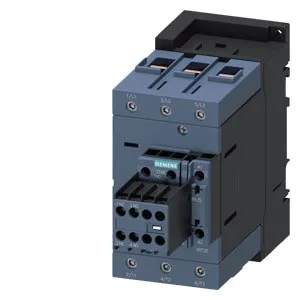
The Siemens 3RT2046-1AP04 is a SIRIUS power contactor in the S3 frame size, rated 96 A at 480 V in AC-3 duty — the motor-switching curve that governs real induction-motor loads on pumps, fans, and compressors. The 70 mm width and 140 mm height fit the S3 footprint, with a 195 mm depth that includes the arc chamber and coil terminals.
The headline 96 A at 480 V is the AC-3 rating — the current the contactor can make and break across a running squirrel-cage motor, where the inrush is roughly 6× full-load but the break is at rated current. That puts it in the range for a 75 HP motor at 480 V three-phase, though always verify locked-rotor current and duty cycle against your specific motor nameplate. Switching frequency limits are 850 operations per hour at AC-3, 900 at AC-1 (resistive), and 250 at AC-4 (plugging/reversing). If your application does frequent inching or jogging, the AC-4 ceiling is the binding constraint.
Termination and wiring notes
Main contacts accept solid conductors from 2.5 to 16 mm² or stranded from 6 to 70 mm² — the stranded range covers the heavier feeds typical for a 96 A circuit. Coil terminals are screw-type, accepting 2x (0.5 to 1.5 mm²) or 2x (0.75 to 2.5 mm²) solid or stranded. No spring-cage here; budget for screwdriver time on the coil connections. Arcing time is 10 to 20 ms, and the contactor includes an auxiliary switch block (1 NO + 1 NC as standard).