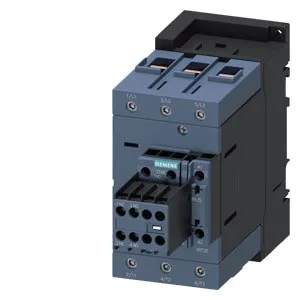
The Siemens 3RT2046-1AR64 is a SIRIUS S3 power contactor with screw-type main contact terminals and an integrated auxiliary switch block. The S3 frame size (70 mm wide, 140 mm high, 195 mm deep) fits standard panel layouts. Rated switching rates tell you the mechanical duty it can sustain: 900 cycles/hour for AC-1 resistive loads, 850 cycles/hour for AC-3 motor starting, and 250 cycles/hour for AC-4 plugging or inching. The AC-3e rating matches the AC-3 figure at 850 1/h. These are the limits for continuous cycling — exceeding them shortens contact life. The auxiliary contact block carries 6 A at 24 V, 2 A at 48 V or 60 V, 1 A at 110 V, 0.9 A at 125 V, 0.3 A at 220 V, and 3 A at 400 V. These are the rated values for the auxiliary circuit — use them to confirm compatibility with your PLC input or relay coil draw.
Wire termination and clearance
Main contact terminals accept solid conductors from 2.5 to 16 mm² and stranded conductors from 6 to 70 mm². Auxiliary terminals accept two conductors per clamp: 0.5–1.5 mm² or 0.75–2.5 mm² solid or stranded. These ranges cover most motor and control wiring in industrial panels. The arcing time is 10–20 ms, and the switching time (at AC) is 10–21 ms — these are the intervals the contactor needs to make or break the circuit cleanly.