Active production — what it means for your BOM line
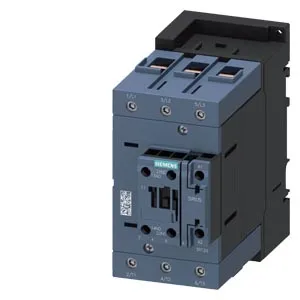
The 3RT2046-1AT60: Part of the Siemens SIRIUS family, rated as a power contactor. Sourced through independent distribution; availability and volume pricing confirmed at RFQ against your line-item quantity.
Motor-duty rating — 96 A at 480 V AC-3
The headline motor-switching rating is 96 A at 480 V — that's the AC-3 current for squirrel-cage motor starting. In a 480 V panel, this contactor handles motors up to about 50 hp (typical rule-of-thumb: 1 hp ≈ 1.8 A at 480 V three-phase). Switching frequency limits vary by duty: 850 operations/hour in AC-3, 350/h in AC-2, and 250/h in AC-4. For high-cycle applications like conveyor indexing, stay within the AC-3 ceiling; AC-4 plugging or inching cuts the rate by more than half.
Mounting and clearance — DIN rail plus air gaps
Mounts via screw and snap-on onto 35 mm standard rail per DIN EN 60715. The contactor body is 70 mm wide, 140 mm tall, 152 mm deep. Minimum clearances: 10 mm upwards, 20 mm forwards, 10 mm sideways, 10 mm downwards. These are the free-air gaps for arc dissipation and cooling — crowding them reduces the switching life. Mounting position allows ±180° rotation on a vertical surface and ±22.5° tilt forward/backward. That flexibility helps when the rail is in a tight enclosure corner.
Wiring — screw terminals, dual conductor capability
Main circuit terminals accept solid 2.5–16 mm² or stranded 6–70 mm². The coil terminals are screw-type and accept 2x (0.5–1.5 mm²) or 2x (0.75–2.5 mm²) solid or stranded. Dual-conductor entry on the coil terminals means you can daisy-chain control voltage without an extra terminal block — saves a rail position.
Environmental limits — storage and operation
Operates from -25 to +60 °C ambient; storage range is -55 to +80 °C. The -25 °C floor matters for unheated plant areas in cold climates — the contactor's mechanical life (10 million operations typical,) assumes the lubricant stays within this band.