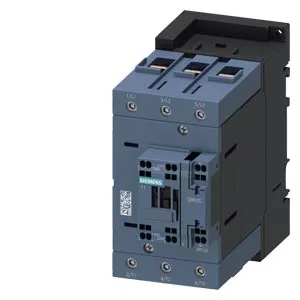
It carries 10 normally-open and 2 normally-closed main contacts, plus an auxiliary switch block built into the frame. The coil connection uses spring-type terminals, so no screwdriver torque check on commissioning; just strip the wire and push it in. Switching rate depends on the duty: AC-1 (resistive) maxes at 900 operations per hour, AC-3 (squirrel-cage motor start/run) at 850 ops/h, and AC-4 (plugging/reversing) at 250 ops/h. The AC-3e rating matches the 850 ops/h figure. That AC-3 number is the one you size for a conveyor or pump motor — 850 starts per hour is generous for most process lines.
That forward clearance is the tight one — the arc chute needs room for gas expulsion during interruption.
Main circuit terminals accept solid conductors from 2.5 to 16 mm², or stranded from 6 to 70 mm². Auxiliary circuit terminals take 2x (0.5 to 2.5 mm²) solid or stranded. The spring-cage design on the coil terminals eliminates re-torquing after thermal cycling — one less thing to check on a PM schedule.
That simplifies BOM freeze and long-term support planning.
The built-in auxiliary switch is rated for 10 A at 24 V, 2 A at 48 V, 2 A at 60 V, 1 A at 110 V, 0.9 A at 125 V, 0.3 A at 220 V, 3 A at 400 V, and 0.8 A at 440 V. The 230 V rating is given as 20 hp — a motor load spec, not a resistive current figure. If you're feeding a PLC input, the 24 V 10 A rating gives plenty of margin for multiple I/O points in parallel.