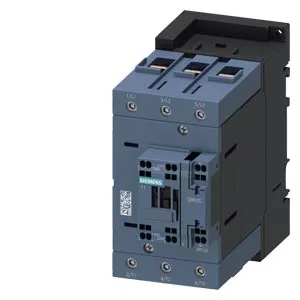
It's a three-pole main contact device with an integrated auxiliary switch, sized for panel builders who need a known footprint and a spring-type coil terminal that accepts 2.5 to 16 mm² solid or 6 to 70 mm² stranded wire. The contactor mounts via screw or snap-on onto 35 mm DIN rail per DIN EN 60715, and the mounting position allows +/-180° rotation on a vertical surface plus +/-22.5° tilt forward and backward. That flexibility matters when you're squeezing it into a tight sub-panel or reusing an existing backplate layout.
The 20 hp at 230 V rating tells you this contactor handles a typical 3-phase induction motor up to that power on a 230 V line. For a 400 V supply, the auxiliary contact is rated at 3 A, which covers most PLC or relay pilot-duty loads. Operating frequency matters: AC-3 duty (standard motor switching) maxes at 850 operations per hour, while AC-4 (plugging or inching) drops to 250 per hour. If your application involves frequent reversing or jogging, that AC-4 limit is the real constraint — not the AC-3 number. That -25 °C floor means it's fine for unheated enclosures in most temperate climates, but if your panel sits in a freezer or arctic environment, you'll need to verify the coil pickup at lower ambients.
The S3 frame measures 70 mm wide, 140 mm tall, and 152 mm deep. That depth is the dimension you need to check against enclosure clearance — 152 mm plus the 20 mm forward clearance means you need about 172 mm from DIN rail to door or back wall. Side clearance is 10 mm, and vertical clearance (up/down) is also 10 mm. The coil connection uses spring-type terminals — no screw tightening, just push the ferrule or stripped wire in. Main circuit wiring accepts 2.5 to 16 mm² solid or 6 to 70 mm² stranded. The auxiliary switch contacts are rated for 10 A at 24 V, 2 A at 48 V, 1 A at 110 V, and 0.9 A at 125 V — enough for most PLC input sensing or relay coil drives.