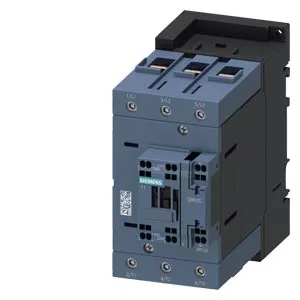
It carries a 83-155 V AC/DC coil that pulls 1.5 A peak inrush and holds at 3.5 VA at 50 or 60 Hz, so it plays well with control transformers sized for that burden. The spring-type terminals on the coil side mean no screw torque check during commissioning; strip, insert, done. Mounting is screw-and-snap onto 35 mm DIN rail per EN 60715, with ±180° rotation on a vertical surface and ±22.5° tilt forward/backward — useful when the panel layout forces an odd orientation. Clearance distances are 10 mm upwards, downwards, and sideways, with 20 mm forward; that's tight enough for most standard enclosures but worth checking if you're shoehorning it next to a drive.
The contactor is rated for 10-2 main contacts — that's 10 normally-open power poles and 2 normally-closed auxiliary contacts built in. The auxiliary contacts are rated 10 A at 24 V, 2 A at 48 V or 60 V, and 1 A at 110 V — those are resistive-load numbers; inductive loads will need derating or arc suppression. Switching frequency tells you the thermal recovery time between operations. At AC-1 (resistive loads) it can cycle 900 times per hour; at AC-3 (squirrel-cage motors, starting only) it's 850 ops/h; at AC-2 (slip-ring motors) it drops to 350 ops/h; at AC-4 (plugging/inching) it's 250 ops/h. The AC-3e rating matches AC-3 at 850 ops/h — that's the IEC motor-starting standard. If your application cycles faster than these numbers, the contactor will overheat the arc chamber. Arcing time is 10-20 ms; switching time (coil energize to main contacts closed) is 38-57 ms on both AC and DC, so it's not a high-speed device — fine for motor starting, not for precision timing.
Wiring and Integration
Main power terminals accept solid wire from 2.5 to 16 mm² and stranded from 6 to 70 mm². The auxiliary terminals take 2x (0.5 to 2.5 mm²) solid or stranded. Dimensions are 70 mm wide, 140 mm high, 152 mm deep.