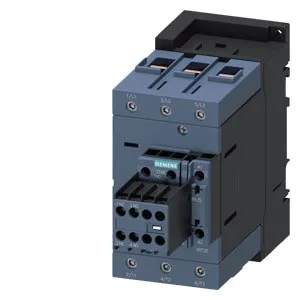
It mounts on a 35 mm DIN rail per DIN EN 60715, with screw and snap-on fastening, and accepts a +/-180° rotation on a vertical surface plus a +/-22.5° tilt forward or backward — useful when fitting into a crowded enclosure where gland-plate clearance is tight. The coil operates on a 20-33 VDC range, so it will pull in reliably on a nominal 24 VDC supply and hold through dips down to 20 V. Inrush current peaks at 6.5 A; steady-state draw is 3.5 VA at both 50 and 60 Hz for the AC variants, but this DC-coil version avoids the hum and heat of an AC coil — a plus for panels with tight thermal budgets. Switching capacity at DC voltages is rated per the table: 6 A at 24 V, 2 A at 48 V, 2 A at 60 V, and 1 A at 110 V. For AC-3 motor duty, the contactor handles up to 850 switching cycles per hour; AC-4 (inching/plugging) drops to 200 1/h. The main contacts are rated for 10 to 2 operations at rated load — a standard endurance figure for this frame size.
The contactor accepts solid conductors from 2.5 to 16 mm² and stranded from 6 to 70 mm² on the main terminals. Auxiliary terminals accept 2x (0.5 to 1.5 mm²) or 2x (0.75 to 2.5 mm²) solid or stranded. The coil connection uses screw-type terminals.