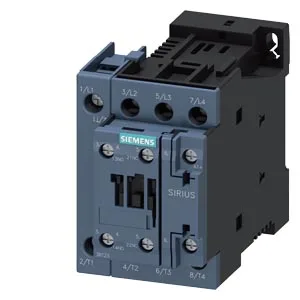
SIRIUS 3RT2326-1BK80 — 52 V DC Coil, Size S0 Contactor
It switches DC loads up to 10 A at 24 V rated value, 2 A at 48 V, and 6 A at 60 V — the 52 V coil sits between standard 48 V and 60 V DC control rails, so verify your control supply tolerance: pick-up is at 0.8 of rated voltage (approx. 41.6 V) and drop-out at 1.1 (approx. 57.2 V), meaning a nominal 48 V bus may not reliably hold it closed. The S0 frame is 60 mm wide, 85 mm tall, 107 mm deep — a standard footprint that fits alongside other S0 accessories. Main contact ratings are given for DC switching across multiple voltage levels: 10 A at 230 V, 3 A at 400 V, 2 A at 500 V, 0.1 A at 600 V, and 1 A at 690 V. The arcing time is 10 ms. Mechanical life is typical 10,000,000 operations.
Main circuit terminals accept solid conductors: 2x (0.5 to 1.5 mm²) and 2x (0.75 to 2.5 mm²). Stranded wire range is 1 to 10 mm². The coil terminals are screw-type, same solid/stranded combinations. Two auxiliary contacts can be attached (the contactor ships with one auxiliary switch present).
Peer Comparison
The closest functional peer is the 3RT2526-1BE40, which shares the same S0 frame size and screw-terminal format but uses a 24 V DC coil. The 3RT2526-1BJ80 and 3RT2526-1BF40 are also S0 contactors with different coil voltages. The 3RT2326-1BK80's 52 V DC coil is the distinguishing feature — it will not drop into a panel wired for 24 V DC without a coil voltage change, but the mechanical footprint and terminal layout are identical, so rewiring the control circuit is the only panel modification needed.