What this contactor is and where it goes
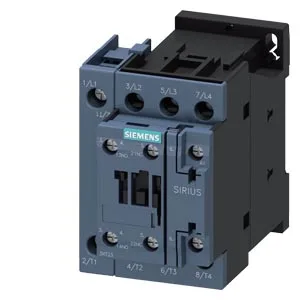
The Siemens 3RT2327-1AH20 is a SIRIUS contactor in frame size S0, built for switching motor loads and resistive circuits in control panels. It snaps onto a 35 mm DIN rail per DIN EN 60715 and can also be screw-mounted — typical for a panel builder who needs a fixed install or wants to pull it for service without loosening a whole bus.
Key ratings and what they mean for fit
The coil is 24 VAC, 50/60 Hz, drawing 0.25 A at 50 Hz and 0.28 A at 60 Hz — a standard control voltage that matches most PLC or relay outputs in North American and European panels. The main contacts are rated for 10 A at 24 V and 230 V, and 3 A at 400 V; that tells you this is a moderate-duty contactor for smaller motors or resistive loads, not a high-current main breaker. The auxiliary switch is built in, rated 10 A at 24 V, 6 A at 60 V, 1 A at 110 V, and so on down to 0.1 A at 600 V — so it can handle pilot duty or signal feedback across a wide voltage range without an add-on block. Ambient operating range is -25 to +60 °C, and storage from -55 to +80 °C. That covers most indoor panel environments and unheated warehouses. The mounting position allows +/-180° rotation on a vertical surface and +/-22.5° tilt forward or backward — useful if the panel layout forces an odd angle.
Physical dimensions and wiring clearances
The contactor measures 85 mm high by 60 mm wide by 97 mm deep. For side-by-side mounting on DIN rail, Siemens specifies 6 mm clearance at the side, 10 mm upwards, 10 mm downwards, and 10 mm forwards — so you can pack these tightly but need that gap for heat dissipation and arc clearance. The screw terminals accept solid wire 2x (0.5 to 1.5 mm²) or 2x (0.75 to 2.5 mm²), and stranded 1 to 10 mm². That covers most control wiring up to about 8 AWG.
