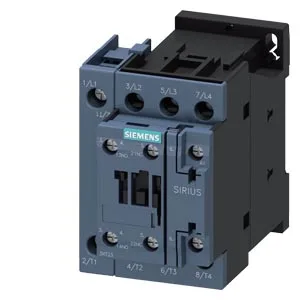
The contactor mounts via screw or snap-on onto standard 35 mm DIN rail per DIN EN 60715, and the mounting position allows +/-180° rotation on a vertical surface plus +/-22.5° tilt forward/backward, which gives flexibility when fitting into tight gland-plate layouts.
The Size S0 frame (85 mm high, 60 mm wide, 97 mm deep) is the mid-range footprint in the SIRIUS contactor family — bigger than S00, smaller than S2. That 97 mm depth means it'll clear most 120 mm deep enclosures, but check your gland plate clearance if you're running wires behind the rail. The coil draws 0.25 A at 50 Hz and 0.28 A at 60 Hz — not a heavy pull, but if you're powering multiple contactors from a single 24 VDC supply (through a converter), those 60 Hz inrush numbers add up. The auxiliary switch is built in (yes, it comes with one), and the main contacts accept solid or stranded wire: 2x (0.5 to 1.5 mm²) or 2x (0.75 to 2.5 mm²) for the control circuit, and 1 to 10 mm² stranded for the power circuit. For a 24 VDC load, it's rated 10 A; at 230 VAC it's 10 A; at 400 VAC it drops to 3 A. That's the thermal current, not the motor-breaking current, so match it to your load type.
The arcing time is listed at 10 to 10 ms — tight and consistent, which helps with coordination in a motor control center.