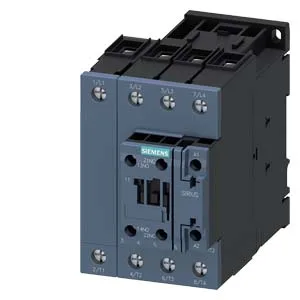
The Siemens 3RT2336-1AV00 is a SIRIUS-branded Size S2 contactor with an AC coil. It's a current-production part, so this is the standard catalog item — not an NRND or obsolete line. It mounts via screw or snap-on onto 35 mm DIN rail per DIN EN 60715, and the mounting position allows +/-180° rotation on a vertical surface plus +/-22.5° tilt forward/backward. That flexibility helps when you're squeezing it into a crowded panel.
The main contact ratings are given across a range of voltages: at 24 V rated value it carries 10 A, at 230 V rated value also 10 A, and at 400 V rated value it handles 3 A. Mechanical life is listed at 10 million operations typical — that's a high-cycle part suited for frequent switching applications like conveyor or pump cycling, not a one-time disconnect. The coil is AC type with screw-type terminals, and the auxiliary switch is included (1 instantaneous contact). For the auxiliary contacts, the rated values span from 10 A at 24 V down to 0.1 A at 600 V — the 24 V 10 A rating is your key figure for interposing relays or PLC outputs.
Wiring terminals accept solid or stranded conductors: 2x (0.5... 1.5 mm²) and 2x (0.75... 2.5 mm²). That's standard for control wiring — no need for special ferrules if you're using 1.5 mm² stranded. Dimensions are 114 mm height, 75 mm width, 130 mm depth — the depth is the dimension that often catches people when retrofitting into existing enclosures.
Environmental range and storage
That covers most industrial environments short of direct oven or freezer placement.