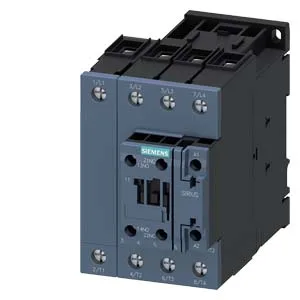
The Siemens SIRIUS 3RT2336-1NE30-0JB0 is a S2 frame contactor with a 48-80 V AC/DC coil, terminated through screw-type connections. It's a current-production part (lifecycle status: current), so it's still rolling off the line, not something you're hunting down as NOS or surplus. It mounts via screw or snap-on onto a 35 mm DIN rail per DIN EN 60715, and the mounting position is flexible — you can rotate it ±180° on a vertical surface, or tilt it forward/backward ±22.5°. That's handy when you're shoehorning it into a crowded panel and the rail isn't perfectly level.
What the Coil Rating Means for Your Circuit
The coil is rated for 48-80 V AC/DC, which means it'll pick up and hold across that whole range. On 50 Hz it draws 2 VA; same on 60 Hz. That's a modest load — your control transformer or 24 VDC power supply won't break a sweat driving it, even with a handful of contactors in parallel. Pickup time is 30-55 ms on both AC and DC, and the arcing time runs 10-20 ms. That's typical for a contactor this size — fast enough for most motor start/stop cycles, but if you're sequencing with a PLC scan, make sure your off-delay timers account for the dropout window.
Wiring and Termination — What Fits the Screws
The main contact terminals accept 2x (0.5-1.5 mm²) or 2x (0.75-2.5 mm²) solid or stranded wire. That covers the common motor leads for a contactor this size — 1.5 mm² for control circuits, 2.5 mm² for power feeds up to maybe a 5.5 kW motor, depending on duty. No need for ferrule adapters unless your shop standard calls for them. It also carries an auxiliary switch block (attachable: 2), so you can add feedback contacts without a separate terminal block if your PLC needs a sealed confirmation of the main contact state.
Physical Fit in the Panel
Dimensions are 114 mm high, 75 mm wide, 130 mm deep. Nothing unusual; just don't butt it against the next device without those gaps for heat dissipation and arc flash clearance. That's wide enough for most indoor panel environments, even unheated warehouses in northern climates. If it's going in a sun-baked enclosure next to a furnace, keep an eye on the internal panel temp — the contactor itself can take it, but the coil life might shorten above 60 °C sustained.