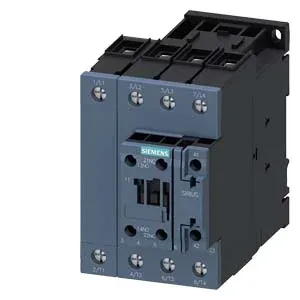
The 3RT2336-1NP30: This is a Siemens SIRIUS contactor, size S2, with a universal AC/DC coil rated 175-280 V. That wide-range coil is the key differentiator — it simplifies panel wiring because you don't need separate AC and DC coil variants, and it rides through brownouts better than a tapped-coil design. The 175 V minimum pull-in means it stays latched on a sagging 208 V line, which matters for sites with weak utility feeds. Main contact ratings: 10 A at 24 V and 230 V, 3 A at 400 V. The auxiliary switch is included, so you get a spare N.O./N.C. set for status feedback or interlocking without adding a side-mount block. Operating temperature range -40 to +70 °C, storage down to -55 °C. That -40 °C low end is unusual for a standard contactor — it's rated for unheated enclosures in cold climates or freezer-plant applications.
Panel Integration & Wiring
The snap-on feature speeds installation on a production line — push on, no tools. Screw terminals on the coil accept 2x (0.5 to 1.5 mm²) or 2x (0.75 to 2.5 mm²) solid/stranded, which covers most control-circuit wiring up to 14 AWG. Dimensions: 75 mm wide, 114 mm high, 130 mm deep — that's a compact S2 footprint, leaving room for a side-mount auxiliary block or a solid-state timer on the rail. That 6 mm side gap is tight — you can pack contactors rail-to-rail without a big air gap, which matters when you're squeezing 10 contactors into a 600 mm wide enclosure. The 10 mm vertical clearance is standard for finger-safe wiring duct.
Performance & Coordination
Coil inrush peaks at 5 A, holding at 2 VA (50/60 Hz). That's a low burden on a PLC output or a 24 VDC power supply — you can drive it directly from a typical 0.5 A solid-state relay without a booster. Compared to the 3RT2027-1NP30-ZX95 (a smaller S0 frame), the S2 frame of the 3RT2336-1NP30 gives you higher continuous current capacity and a wider coil voltage range. The S0 tops out around 7 A at 400 V; the S2 handles 3 A at 400 V but with a larger contact gap for better arc extinction. If your load is under 5 A at 400 V and you need the smallest footprint, the S0 is the tighter fit; for the 175-280 V coil flexibility and the cold-temperature rating, the S2 is the better pick.