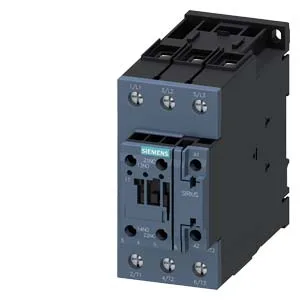
It carries a 20-33 VDC coil rated for continuous duty, with a pick-up tolerance of 0.8 to 1.1 times the rated value, meaning the coil reliably pulls in at 16 V and holds in up to 36.3 V. The main contacts are 3-pole normally open (18...1 configuration), and the contactor includes a factory-fitted auxiliary switch (1 NO + 1 NC) with ratings of 10 A at 24 V, 2 A at 48 V, 2 A at 60 V, 1 A at 110 V, 0.9 A at 125 V, and 0.3 A at 220 V — all resistive. This auxiliary switch is wired via screw-type terminals, matching the main coil terminals.
Dimensions are 55 mm wide, 114 mm high, and 130 mm deep, so it occupies a standard S2 footprint on the rail. Wire cross-section for main and auxiliary terminals accepts 2x (0.5 to 1.5 mm²) or 2x (0.75 to 2.5 mm²) solid or stranded.
Maximum operating frequency varies by duty class: 1,000 operations per hour for AC-1 (resistive), 600/h for AC-2 (slip-ring motor), 800/h for AC-3 and AC-3e (squirrel-cage motor starting), and 250/h for AC-4 (plugging/inching). These figures matter for coordinating with upstream protection and for applications requiring frequent switching — AC-4 duty at 250/h is the limiting case for high-inertia loads.