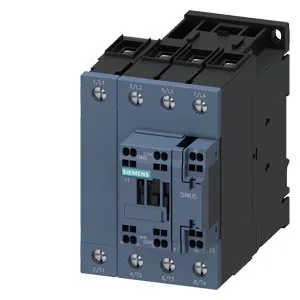
The DC coil draws an inrush current peak of 1.5 A and has an operating time of 30 to 55 ms at DC, with an arcing time of 10 to 20 ms. That arcing window is short enough for most motor-starting duty cycles but matters for coordination with upstream protection — a fast-acting semiconductor fuse might see that arc as a fault. The contactor is rated for switching at various voltages: at 24 V rated value it handles 10 A, at 110 V rated value 1 A, at 230 V rated value 10 A, and at 600 V rated value 17 A. These are the switching ratings under specific conditions — the 600 V / 17 A point, for example, is likely the AC-1 resistive load curve; for motor loads (AC-3) you'd derate.
Panel integration and clearances
Dimensions: 130 mm depth, 55 mm width, 114 mm height. The width is the critical number for DIN-rail fill — at 55 mm it occupies three standard 18 mm module spaces plus a sliver, so plan your rail accordingly. That side clearance is tighter than the others; if you're packing multiple contactors side-by-side, maintain that 6 mm gap for heat dissipation and arc-quenching. The spring-type terminals on the coil accept 2x (0.5 to 2.5 mm²) solid or stranded, which covers most control wiring gauges.