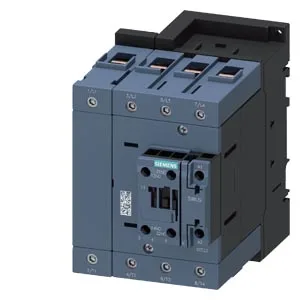
The Siemens 3RT2346-1AL20 is a SIRIUS contactor in the Size S3 frame, fitted with a screw-type 230 V AC coil and a built-in 2-pole auxiliary switch block. It mounts via screw or snap-on onto standard 35 mm DIN rail per DIN EN 60715, and the mounting position allows ±180° rotation on a vertical surface plus ±22.5° tilt forward/backward — useful when you're squeezing it into a crowded panel and need to orient the coil terminals for access. Wire terminations accept solid conductors from 0.5 to 2.5 mm² (two per clamp) and stranded up to 70 mm² for the main power circuit — so you can land a 50 mm² motor feeder without a ferrule adapter.
The envelope is 140 mm high, 96 mm wide, and 152 mm deep — a standard Size S3 footprint that drops into most DIN-rail enclosures without surprises. Switching times: AC make/break is 10 to 21 ms; arcing time is 10 to 20 ms. Shock resistance is rated at 10.6 g for 5 ms and 6.3 g for 10 ms — relevant if the panel is mounted on a vibrating conveyor or a mobile platform.
The closest functional peer in the SIRIUS line is the 3RT2037-1AL20-ZX95. Both are Size S3 contactors with a 230 V AC screw-type coil and a 2-pole auxiliary block. The 3RT2037 variant carries a special customer-specific version code (ZX95), which typically means a factory-applied marking or packaging variant — the electrical ratings and mounting footprint are identical. For a panel originally specified around the 3RT2037-1AL20-ZX95, the 3RT2346-1AL20 will drop into the same rail position and wire up without rewiring, provided the auxiliary contact configuration matches your control scheme.