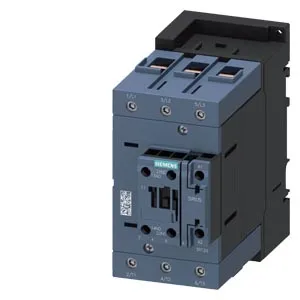
Siemens 3RT2446-1NE30 SIRIUS Contactor — Key Specs and Fit
Its coil draws 3.5 VA at both 50 Hz and 60 Hz, with an inrush peak of 1.1 A. Main power wiring accepts stranded conductors from 6 to 70 mm². The auxiliary circuit uses screw-type terminals accepting solid or stranded wire: 2x (0.5-1.5 mm²) and 2x (0.75-2.5 mm²). The contactor comes with an auxiliary switch built in, and up to 2 additional auxiliary contact blocks can be attached.
Switching Capacity and Coil Details
The coil operates on a universal AC/DC supply with a rated voltage range of 48-80 V. This makes it suitable for control systems with a nominal 48 V or 60 V DC bus, or 48 V AC control transformers. Switching capacity is specified at various voltages for the main contacts: 10 A at 24 V, 2 A at 48 V, 2 A at 60 V, 1 A at 110 V, 0.9 A at 125 V, 0.3 A at 220 V, 6 A at 230 V, and 3 A at 400 V. These ratings are typically for DC or resistive loads; for AC-3 motor duty, the S3 frame size is rated for higher currents (the specific AC-3 rating is not in this evidence, but the S3 frame is commonly used for motors up to about 132 kW at 400 V).
The part carries no official successor because it is the current model. If you are cross-referencing from an older SIRIUS generation, the 3RT2446-1NE30 is the direct replacement for earlier Size S3 contactors with similar coil voltage. No functional second-source is listed in the evidence, but the Siemens SIRIUS platform is widely used and parametric equivalents exist from other manufacturers.
Integration and Environmental Limits
The contactor is designed for panel mounting on DIN rail, with screw-type terminals for both power and control wiring. Dimensions are 140 mm height, 70 mm width, and 152 mm depth. For panel builders: the 70 mm width occupies 4 DIN modules (1 module = 17.5 mm). The 152 mm depth is a standard S3 frame dimension that fits most 200 mm+ deep enclosures. Allow the specified clearances for arc flash and ventilation. The screw-type coil terminals are standard, not cage-clamp — factor in screwdriver access during wiring.