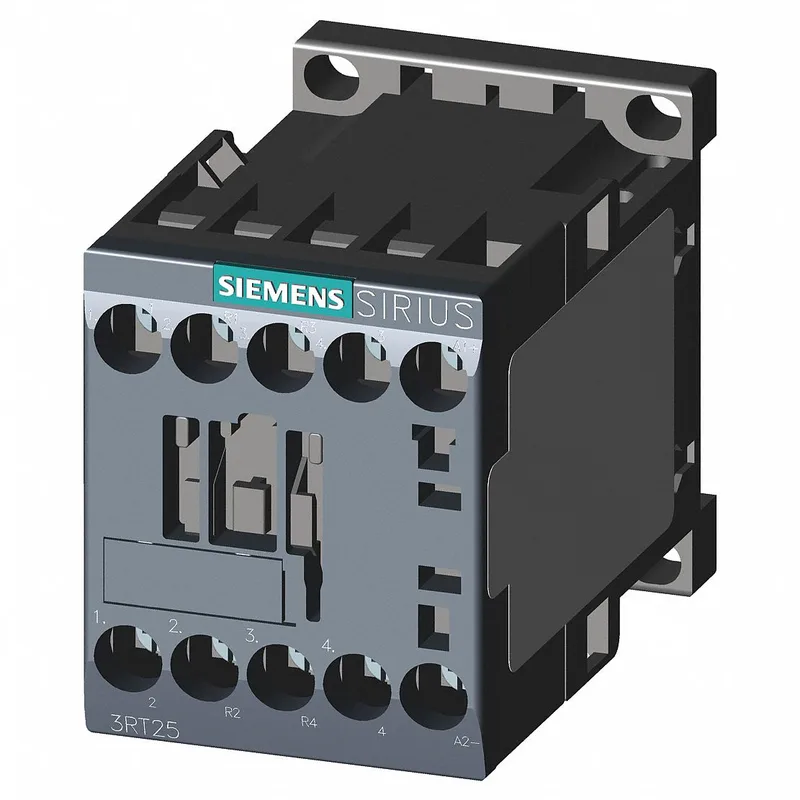
The 3RT2516-1AP60: Size S00 keeps the footprint tight: 45 mm wide, 57.5 mm tall, 73 mm deep. That's a 45 mm bin slot on the DIN rail, same as a typical 3-pole miniature breaker. Mounts via screw and snap-on onto 35 mm DIN rail per EN 50022, and the mounting position allows ±180° rotation on a vertical surface plus ±22.5° tilt forward/backward — useful when you're squeezing it into a crowded gland-plate area. Its contact ratings cover the common control voltages: 10 A at 24 V and 230 V, 2 A at 48 V and 125 V, 3 A at 400 V, and 0.1 A at 600 V.
Compared to the 3RT1017-1AP01, the 3RT2516-1AP60 is a different generation — the 3RT1017 is an older 3RT1 frame. The 3RT2516 shares the same S00 size and 45 mm width, so it will physically fit a panel designed for the 3RT1017 without drilling new holes. The terminal style differs: the 3RT2516 uses screw-type terminals; the 3RT1017 may use cage-clamp depending on the suffix. If your existing wiring is ferruled stranded, the 3RT2516 accepts 2x (0.5...1.5 mm²), 2x (0.75...2.5 mm²), or 2x 4 mm² solid or stranded — check your wire gauge against that range before swapping.
Wire termination uses screw-type terminals. Strip length is standard for screw clamps — 8 to 10 mm typically. The auxiliary contact block is integral, so no extra wiring for a basic N.O./N.C. feedback pair. Coil draws at 24 VDC; verify your control transformer sizing if you're ganging several contactors on one supply. Clearance requirements: zero mm spacing needed upwards, forwards, backwards, and downwards for side-by-side mounting. Only 6 mm clearance required at the side. That means you can pack these tight on the DIN rail without derating for heat buildup in a standard control panel. The switching frequency at DC is rated at 10,000 operations per hour, and at AC-1 maximum it's 1,000 operations per hour. Arcing time runs 10 to 15 ms, with AC operate/release times of 4 to 15 ms.