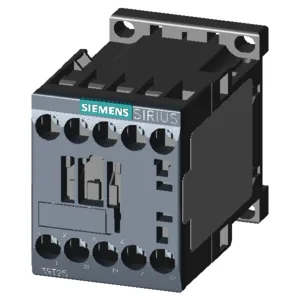
SIRIUS S00 Contactor with Spring-Terminal Coil Connection
Its 110 V AC coil (rated value) pulls in at 80% of nominal (0.8 initial value) and holds up to 110% (1.1 full-scale value), giving you a clean pickup band for brownout conditions. The coil termination uses spring-type terminals, while the main current circuit also uses spring-loaded terminals — no screwdriver needed for the coil connection, which speeds up panel wiring and eliminates re-torque checks. Side-by-side mounting is supported, with zero clearance required upwards, forwards, and backwards, 0 mm downwards, and only 6 mm at the side — so you can pack these tight on the rail without derating for proximity.
The built-in auxiliary switch carries a range of voltage-specific current ratings that define its switching capability across different control voltages. At 24 V rated value it handles 10 A, at 48 V it's 2 A, at 60 V also 2 A, at 110 V it drops to 1 A, at 125 V it's 2 A, at 220 V it's 0.3 A, at 230 V it jumps back to 10 A, at 400 V it's 3 A, at 440 V it's 0.8 A, and at 600 V it's 0.1 A. The 10 A at 230 V is the standout — that's a full-rated auxiliary contact for 230 VAC pilot duty, not a derated figure. The arcing time is 10 to 15 ms, and the maximum mechanical switching rate at AC is 10,000 operations per hour, with a maximum at AC-1 of 1,000 operations per hour.
Wiring and Environmental Limits
That's a standard range covering most control wiring up to 12 AWG. Mechanical endurance of the contactor typical is 30,000,000 operations — that's the mechanical life, not the electrical life under load, which will be lower depending on the switched current and duty cycle.