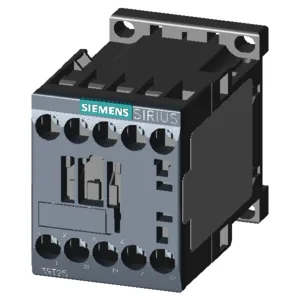
The coil termination is also spring-type, so no screwdriver torque check on those either. Rated operational currents are specified per voltage and duty: at 24 V rated value it carries 10 A, at 48 V rated value 2 A, at 60 V rated value 2 A, at 110 V rated value 1 A, at 125 V rated value 2 A, at 220 V rated value 0.3 A, at 230 V rated value 10 A, at 400 V rated value 3 A, at 440 V rated value 0.8 A, and at 600 V rated value 0.1 A. These are the currents the contactor can switch at those voltages — pick the row that matches your control voltage and load type. The auxiliary switch is present, so you get a built-in N.O./N.C. set for feedback or status indication without adding a side-mount block. Mechanical life of the contactor typical is 30,000,000 operations — that's the rated endurance before wear-out, not a guarantee, but it sets expectations for high-cycle applications.
That's the standard top-hat rail in every control panel. Dimensions: 45 mm width, 70 mm height, 73 mm depth. That means you can gang them tight on the rail without extra spacing except the 6 mm side gap — useful when packing multiple contactors in a row. If the panel ambient pushes past 60 °C, you need to derate or move the contactor to a cooler zone.