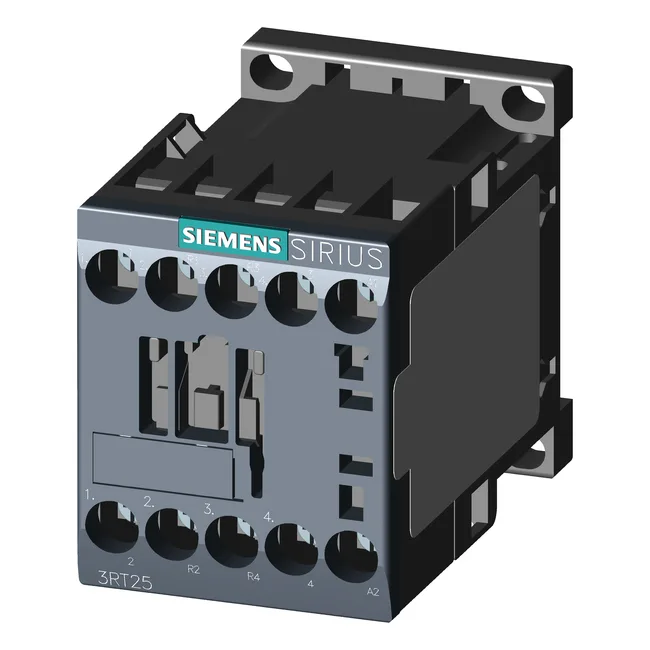
It's built for panel integration — screws onto the backplate or snaps onto 35 mm DIN rail per EN 50022, and the mounting position is flexible: ±180° rotation on a vertical surface, plus ±22.5° tilt forward or backward. That means it fits into tight enclosures where you need to orient the contactor around busbars or duct.
This contactor is rated for DC switching across a range of voltages, and the current capability drops sharply as voltage rises — that's the physics of DC arc extinction. At 24 VDC it handles 10 A; at 48 V and 60 V it's rated 2 A; at 110 V it's 1 A; at 220 V it drops to 0.3 A; and at 600 V it's only 0.1 A. The arcing time is 10-15 ms, and the DC switching frequency is 7-13 ms. If you're switching a 24 VDC solenoid bank or a small DC motor brake, the 10 A rating gives you headroom. For a 110 VDC control circuit pulling 0.5 A, you're fine. But don't spec this for a 600 VDC string — the 0.1 A limit means it's really just for signal-level switching at that voltage.
AC Switching and Mechanical Life
The maximum mechanical switching frequency is 10,000 operations per hour, and at AC-1 resistive load it's 1,000 per hour. For a conveyor line cycling once every 30 seconds, that's about 28 years of service before the mechanism wears out. The coil pickup is at 80% of rated voltage (88 VDC for this 110 V unit), and the dropout threshold is 1.1 times the full-scale value — so it holds in well but drops cleanly when the control signal goes away.
Integration and Clearance
The contactor is 45 mm wide, 70 mm high, and 73 mm deep — a standard S00 footprint. Zero clearance needed above, below, forward, or backward.