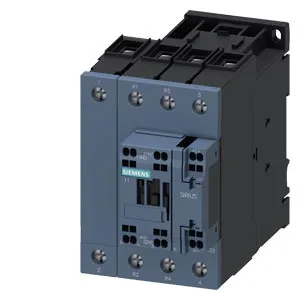
Integrator's first read
Its DC coil is rated at 110 V, with a spring-type terminal connection for the magnet coil — no screw torque to verify on that circuit, just strip and insert.
DC switching capacity — what the ratings mean
The contactor's DC switching capacity is specified per voltage level, not as a single maximum current. At 24 V it handles 10 A; at 48 V and 60 V, 2 A; at 110 V, 1 A; at 220 V, 0.3 A; at 400 V, 3 A; at 600 V, 0.1 A. These are the make/break ratings for DC loads — resistive or slightly inductive — and they drop sharply above 24 V because DC arcs sustain longer than AC. For AC-4 duty (switching motor loads with inrush), the maximum switching frequency is 300 operations per hour. Main contacts are configured as 3 normally open (3 NO) for the power circuit, plus one auxiliary switch (1 NO/1 NC) for feedback or interlocking. The inrush current peak for the coil is 1.5 A.
Panel layout and wiring
Dimensions: 75 mm wide, 114 mm high, 130 mm deep. These are the minimum free air gaps around the contactor for arc flash and heat dissipation — factor them into your DIN-rail layout. Terminals accept solid or stranded conductors: 2x (0.5 to 1.5 mm²) or 2x (0.75 to 2.5 mm²) per clamp. The spring-type coil terminal is the same gauge range — no ferrule required but recommended for stranded wire to avoid fraying.
The lifecycle stage for 3RT2535-3XF40-0LA2 is listed as current production. No phase-out or last-time-buy notice is attached to this order code.