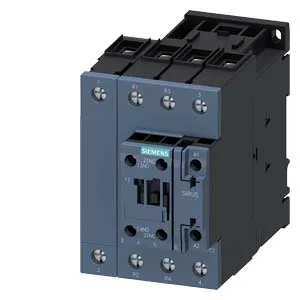
It snaps onto standard 35 mm DIN rail per DIN EN 50022 and can be mounted in any orientation — ±180° rotation on a vertical surface, plus ±22.5° tilt forward or backward. That flexibility means it fits into tight panel layouts without reworking the gland plate. Width is 75 mm, height 114 mm, depth 130 mm. Clearance: 50 mm above and below, 10 mm to the side, zero forward or backward — so you can pack it close to the backplane or adjacent devices as long as vertical breathing room is respected.
The auxiliary contact block handles 10 A at 24 V AC or 230 V AC — that's the same current rating for both the low-voltage control side and the line-voltage signal side, so you don't need separate derating for the 24 V loop. At 48 V AC it drops to 2 A, and at 400 V AC it's 3 A. Coil pickup and dropout timing: arcing time is 10 to 20 ms, and the operate time at AC is 10 to 18 ms. That's fast enough for most motor-starting sequences but worth noting if you're sequencing contactors in a reversing starter — the overlap window is tight.
Screw terminals accept solid or stranded wire: two conductors of 0.5 to 1.5 mm², or two of 0.75 to 2.5 mm². That covers standard control wiring (1.5 mm² for signal, 2.5 mm² for power feed-through). No special ferrules needed, but stranded wire benefits from bootlace ferrules for a clean clamp.